RoboFlyWheel-World

RFW-W: Scaling Physical Asset Universes
for Generative Embodied Simulation

Jiawei Weng1,* Rui Zhang1,2,* Saining Zhang2,3,*,† Changjian Pan2,4,* Yuanbo Lyu1,* Jiarui Guo1,2,*
Yongzhi Li3 Guolin Liu2 Jialu Liu2 Jiankun Wang2 Yi Yang1 Peishuo Li3
Zhiheng Li2 Jiaying Wan2 Junhao Chen2 Weiqing Xiao5 Jingrun Du1,2 Wenyi Li1,2 Weiyi Lin1
Zenan Meng1,‡ Hu Wei1,‡ Lin Qu1 Zongzheng Zhang2 Hao Zhao2 Chaojian Li6,‡

1 Alibaba Group 2 Tsinghua University 3 Nanyang Technological University 4 Peking University 5 Nanjing University 6 Hong Kong University of Science and Technology

* Core contributors† Project leader‡ Corresponding authors

mengzenan.mzn@alibaba-inc.com kongwang@alibaba-inc.com chaojian@ust.hk

Paper · Rigid asset study

Building objects for physical interaction

RFW-R pairs a textured surface with semantic parts, collision geometry and physical properties. A task can then retrieve a cup by what it is, place it by its measured size and simulate contact using its collision hulls.

524,611Retained rigid assets
1,212Rigid object categories
6Hand models used for grasp annotation

Method · RFW-R and task scenes

From object to task scene

The rigid pipeline builds an object that a simulator can load. The scene pipeline then places task-relevant objects before it constructs the room around them.

01 · Asset level

Rigid asset construction
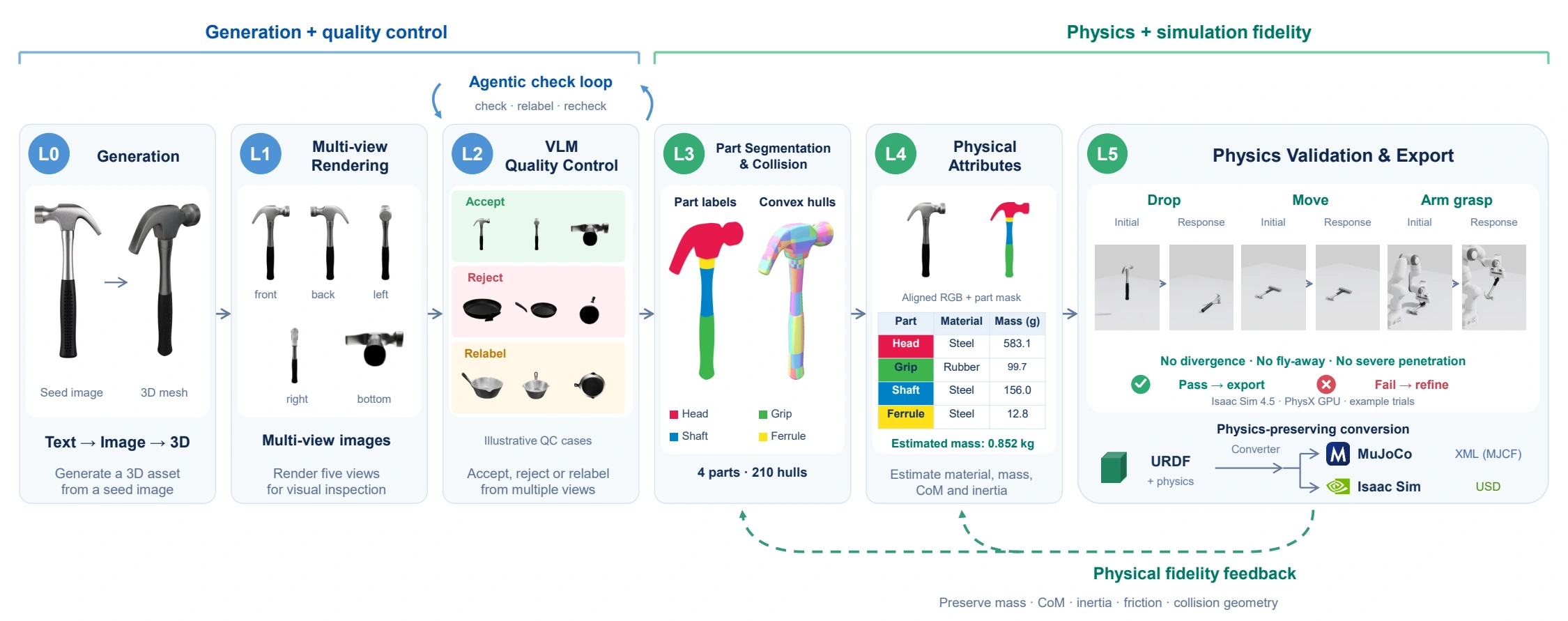
Rigid asset stages L0 to L5, from category-guided mesh generation to physical evaluation
  1. Generate and inspect

    Reconstruct a textured mesh and inspect it from several views. Reject incomplete objects or correct their category.

  2. Build the physical model

    Label functional parts, build convex hulls and combine part properties into mass, center of mass and inertia.

  3. Export for simulation

    Package the visual mesh, collision geometry and physical properties for import into multiple simulators.

Rigid asset collection

Explore RFW-W assets

Rigid objects packaged for import into multiple simulators, with textured surfaces for rendering and convex geometry for contact.

The local review media bundle is not attached.
02 · Scene level

Task-conditioned scene construction

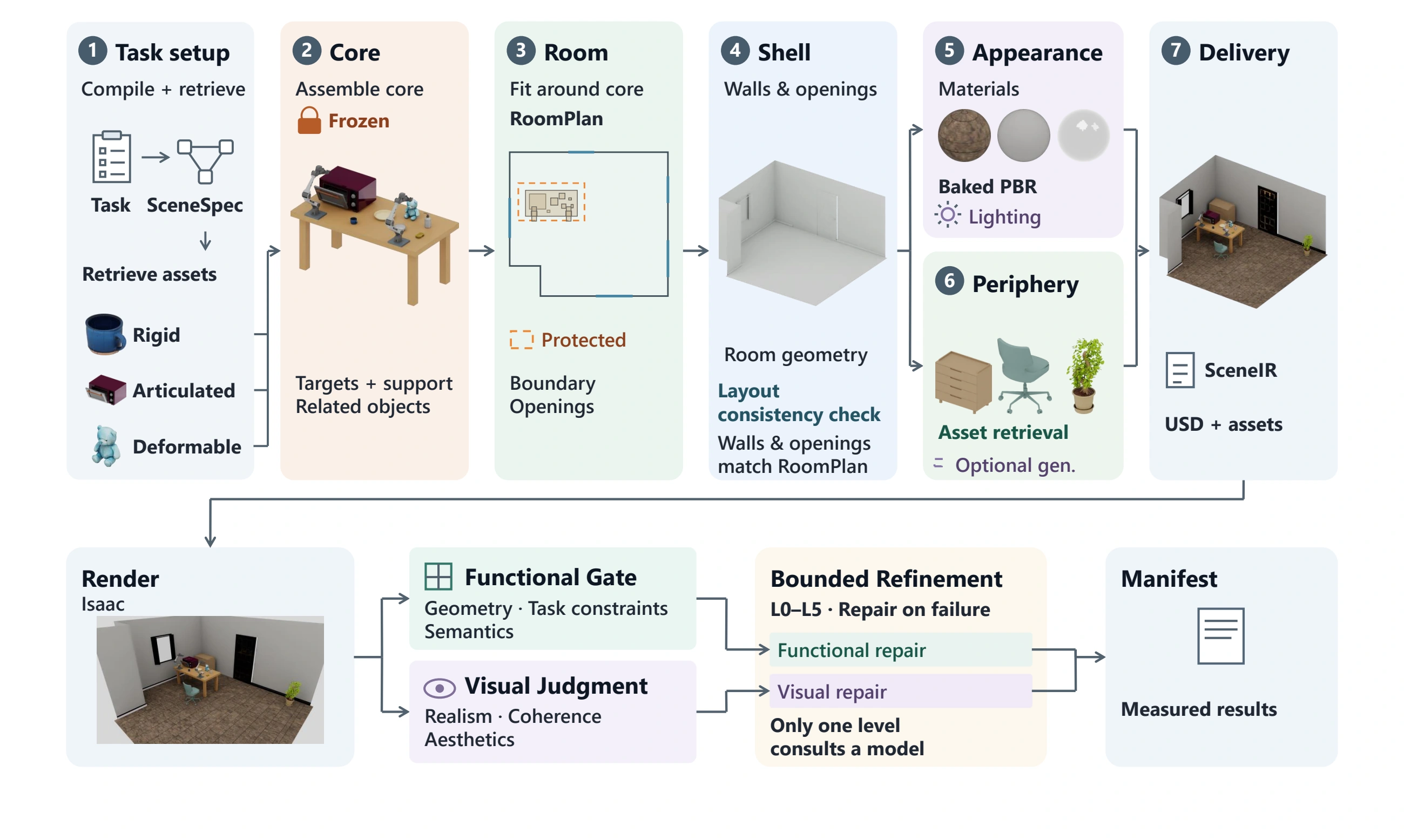
Scene pipeline: retrieve rigid, articulated and deformable assets, assemble the task core, build the room, validate and export
  1. Retrieve and place objects

    Use the task specification to retrieve compatible objects from rigid, articulated and deformable collections. Place the targets and their supports, then freeze their relative poses.

  2. Build the room

    Fit walls and openings around the task objects, then add surrounding furniture, materials and lighting.

  3. Check and export

    Check geometry, task constraints and visual consistency. Repair the layout around the fixed objects and export the scene for Isaac Sim.

Objects in action

Task-conditioned scenes

Recorded operations in a coffee corner, a study, a garden balcony and a laundry room.

The local scene recordings are not attached.